
Understanding International Remains Repatriation Timelines
When someone you love passes away in another country, you need to know how long it will take to bring them home to the United States. You’re planning a funeral, respecting cultural or religious customs and coordinating family members traveling from different places — all while navigating grief.
The timeline for bringing your loved one home depends on several factors, from documentation requirements to destination-specific regulations. Understanding these timelines can bring clarity when you need it most, allowing you to focus on your family and honoring your loved one’s memory.
How Long Does International Repatriation Take?
International repatriation of human remains typically takes between seven and 21 days, depending on the destination country, documentation status and flight availability. Straightforward cases with complete documentation and accessible destinations move toward the shorter end of that range. Complex paperwork requirements, remote locations or countries with lengthy consulate processes extend timelines closer to three weeks or longer.
According to International Air Transport Association (IATA) guidelines for compassionate transportation, the process begins with booking and complete documentation before your loved one can be accepted for their journey home.
Overseas repatriation timelines vary significantly by region. Mexico can be completed in as little as seven days, while Asian destinations typically require approximately two to three weeks due to more complex documentation and consulate processing windows.
What Happens During the Repatriation Process
Understanding the steps involved can provide clarity during an emotional time. The repatriation process follows a structured sequence designed to keep families informed:
- Initial discussion: A dedicated coordinator will connect with you to gather the necessary details about your situation and your loved one’s location. This conversation establishes what needs to happen and when.
- Planning and documentation: A comprehensive plan outlines every step, including required documentation, coordination with consulates and funeral homes and transparent cost information.
- Coordination and transport: The team executes the plan, managing all paperwork, consulate communication, airline bookings and ground transfers on your behalf. You receive regular updates throughout this phase.
- Arrival confirmation: A final notification confirms your loved one has arrived safely at their destination and the transfer to the receiving funeral home is complete.
This approach ensures you never navigate the process alone.
Factors That Affect Repatriation Timelines
Several variables determine where a family falls within that seven to 21-day range, with documentation and destination-specific requirements playing the most significant roles.
1. Documentation and Consulate Coordination
The shipping of human remains internationally requires coordination among multiple government agencies and careful attention to paperwork. Documentation is the single biggest driver of timeline variance. A missing or mismatched document can delay shipment by days or even weeks.
Many destination countries require different document types to authorize international repatriation:
- Local death certificate: Issued by the state or county vital records office where the death occurred; this is the foundational document for all subsequent paperwork.
- Funeral director’s affidavit: A local funeral director’s statement confirming preparation of the remains and compliance with regulations.
- Transit permit: Authorization allowing the shipment to be transported across borders.
Consulate processing times vary significantly by country — some local authorities may process documentation within 48 hours, while others take several days. An experienced partner in consulate coordination keeps the process moving and provides peace of mind during an overwhelming time.
2. Country Requirements and Flight Availability
Every destination country layers on its own requirements beyond the standard documentation. Some countries require apostilles, an official certification of document authenticity. They might also require language translations of all paperwork, additional health ministry certificates or specific container types. These country-specific regulations add days to the timeline if not anticipated early in the process.
Flight scheduling matters, too. Once the documentation is cleared, shipments are booked as cargo on a commercial airline. Known Shipper status with major airlines provides access to passenger flights rather than cargo-only aircraft, offering more frequent and direct routing options.
Repatriation Timelines by Region
While every case is unique, the following timelines reflect what families typically experience when coordinating repatriation from the United States.
Mexico
Repatriation to Mexico can be completed in seven days. Key variables include obtaining the Mexican Consulate Visado de Tránsito (transit permit) and ensuring Spanish-language translations of all documentation are accurate and complete. Coordination with the receiving funeraria (funeral home) in Mexico is essential for a smooth process, and families benefit from working with a partner experienced in Mexican consular requirements.
The Caribbean
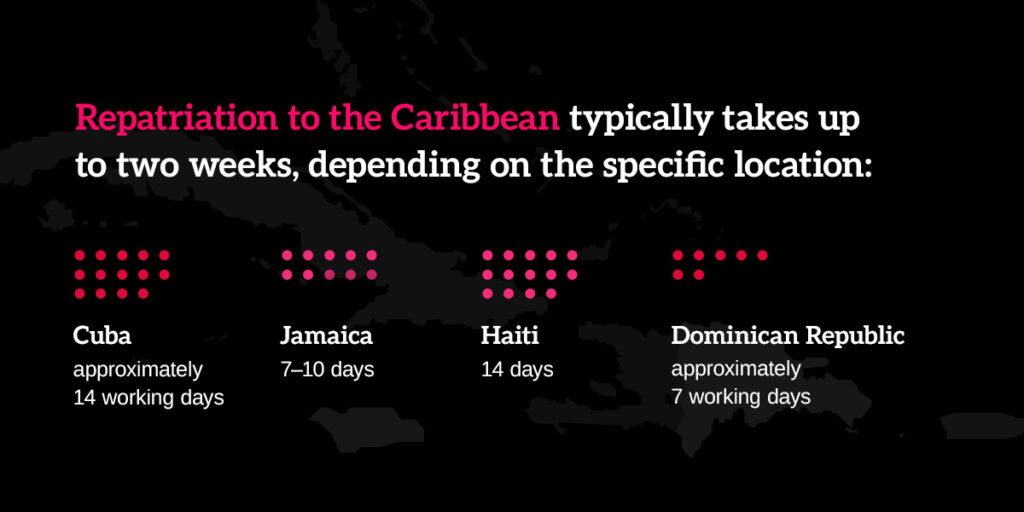
Repatriation to the Caribbean typically takes up to two weeks, depending on the specific location:
- Returning remains to Cuba takes approximately 14 working days and may require translations, notarization, and, in some cases, permits.
- Repatriation to Jamaica may take 7–10 days.
- Transporting remains to Haiti via routes through Santiago may be completed in as little as 14 days.
- Repatriation to the Dominican Republic takes approximately seven working days.
These timelines are subject to airline cargo availability and correct documentation. Limited direct flights or processing delays may extend the journey.
Central America
Repatriation to Central America locations takes approximately 14 days. Timelines may vary based on flight availability and destination-specific permits. An experienced partner can coordinate with the relevant authorities, airlines, and funeral homes on your behalf during an already difficult time.
South America
Repatriations to South America take approximately 14 working days. Documentation-heavy countries requiring multiple government certifications or additional health ministry approvals may extend this timeline. The right partner will coordinate directly with consulates in the region, managing the multistep process so you do not have to navigate complex international requirements alone.
Africa
Repatriation to Africa may be completed in as little as 14 working days. Timelines vary, as each African country has its own documentation, consular and airline requirements. The right partner will have experience working with the relevant authorities, airlines and receiving funeral homes.
Canada
Repatriation to Canada may be completed in as little as seven days. Although the United States and Canada share a border, transport still requires complete documentation and permits, as well as compliance with both countries’ regulations. Depending on the destination, arrangements may involve air or ground transportation and coordination with funeral homes.
Russia
Repatriation to Russia varies by case. Transport requires strict documentation and coordination with the Russian consulate. Compliance with government and airline regulations is also a necessity. Working with a partner experienced in Russian consular and government requirements supports careful coordination and dignified transportation throughout the process.
Europe
Repatriation to Europe varies more than in other regions. Many Western European destinations move in 7–10 days. Countries with more layered documentation requirements — such as those in Eastern Europe or the Balkans — take longer. UK-bound repatriations from the United States typically take 7–14 working days and require coordination with the British Consulate for entry documentation.
Asia
Repatriation to Asia typically requires approximately two to three weeks. Asian repatriations often involve more documentation steps and longer consulate processing windows than other regions. Countries across Asia each carry distinct requirements.
U.S. Territories
Many families are surprised that U.S. territories have coordination requirements similar to those for international destinations. The five inhabited territories still need airline cargo booking and proper documentation. The process typically takes 5–10 working days. Fewer consular steps are involved than for international destinations, but coordination requirements remain essential to ensuring dignified and compliant transport.
Australia and Oceania
Repatriations to Australia and Oceania typically fall in the two- to three-week range due to geographic distance and multistep approval requirements. For a full list of destinations and region-specific guidance, experienced coordinators can provide the clarity families need during this challenging time.
Contact International Remains Shipping
You do not have to navigate any of this alone. International Remains Shipping manages every step of the repatriation process. We coordinate obtaining local death certificates, assist with consulate approvals, arrange airline cargo and connect with the receiving funeral home. Our repatriation coordination services ensure your loved one’s dignified journey home, and our Known Shipper status with major airlines supports careful handling throughout. The result is peace of mind when you need it most.
To discuss your family’s timeline and needs, call us at 561-228-1161 or fill out our online contact form.